

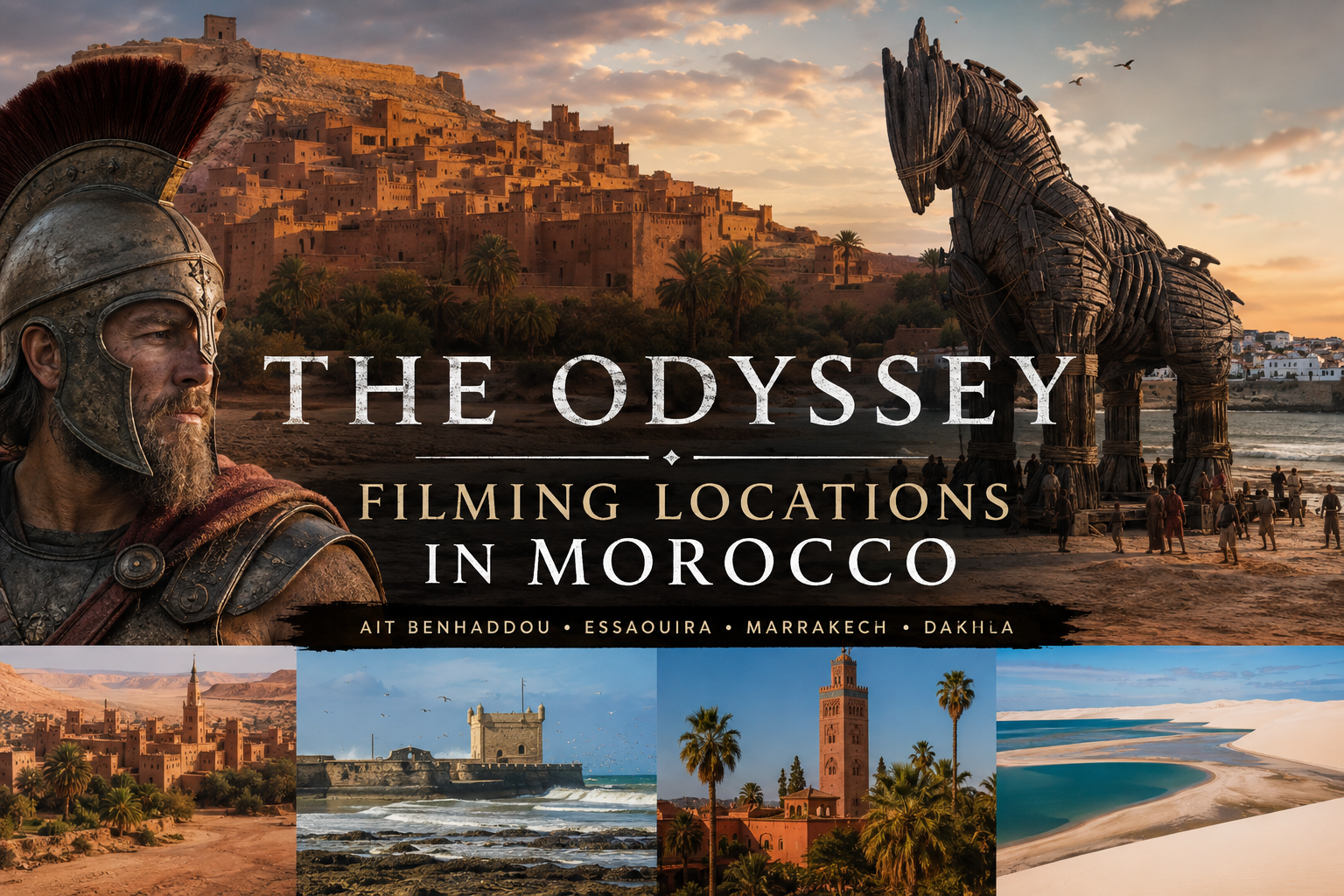
Christopher Nolan’s The Odyssey has brought one of the greatest stories ever told to the big screen, taking audiences on an epic journey through the world of Homer’s ancient Greek legend. Starring Matt Damon as Odysseus alongside Tom Holland, Zendaya, Robert Pattinson, Anne Hathaway, Lupita Nyong’o and Charlize Theron, the film combines mythology, adventure and spectacular real-world landscapes.
What makes The Odyssey especially interesting for travelers is that some of its most impressive scenes were filmed in Morocco.
From the ancient-looking walls of Aït Benhaddou near Ouarzazate to the Atlantic beaches of Essaouira, Morocco provided some of the landscapes Christopher Nolan used to recreate the legendary world of Troy and Odysseus.
For travelers visiting Morocco, this creates an exciting opportunity: you can visit several of the real landscapes that appeared in The Odyssey and combine them with some of the country’s most famous cultural and natural attractions.
In this guide, we will explore where The Odyssey was filmed in Morocco, which Moroccan locations appear in the film, what they represented, and how you can visit them during a Morocco trip.
What Is Amazing About Christopher Nolan’s The Odyssey?
The Odyssey is Christopher Nolan’s adaptation of Homer’s ancient epic poem, The Odyssey.
The story follows Odysseus, the legendary king of Ithaca, as he attempts to return home after the Trojan War. His journey becomes an extraordinary adventure involving gods, monsters, warriors, mythical islands and dangerous encounters.
The original story has been told for thousands of years, but Nolan presents it as a large-scale cinematic adventure using real landscapes, practical sets and large-format IMAX photography.
Matt Damon plays Odysseus, while the ensemble cast includes Tom Holland, Robert Pattinson, Zendaya, Anne Hathaway, Lupita Nyong’o and Charlize Theron.
The film was shot across several countries, including Morocco, Greece, Italy, Iceland, Scotland and the United States, allowing Nolan to create different parts of the mythical world using real locations.
Why Did Christopher Nolan Film The Odyssey in Morocco?
Morocco has been one of the world’s favorite filming destinations for decades.
Its landscapes can represent many different historical periods and geographical regions. Within a relatively short distance, filmmakers can find ancient-looking villages, fortified kasbahs, mountains, deserts, rocky landscapes and Atlantic beaches.
For a film based on an ancient epic, this variety is particularly useful.
Morocco also has a long history of hosting major international productions. Places around Ouarzazate and Aït Benhaddou have previously appeared in films and television productions such as Lawrence of Arabia, Gladiator, The Mummy and Game of Thrones.
For The Odyssey, Morocco offered something particularly valuable: landscapes that could convincingly transport audiences thousands of years into the past.
Where Was The Odyssey Filmed in Morocco?
Several Moroccan locations were involved in the production.
The most important locations associated with the film include:
- Aït Benhaddou
- Ouarzazate
- Essaouira
- Marrakech
- Tahanaoute and the surrounding El Haouz region
- Dakhla and the White Dune area
Not every location played the same role, and it is important to distinguish between places where principal scenes were filmed, production areas and landscapes identified through post-release location research.
Let’s take a closer look at the most important Moroccan locations.
Aït Benhaddou: The Moroccan Troy
If there is one Moroccan location that The Odyssey fans should put at the top of their list, it is Aït Benhaddou.
Located near Ouarzazate in southern Morocco, Aït Benhaddou is a spectacular fortified ksar built from traditional earthen architecture. The site is recognized as a UNESCO World Heritage Site and is one of Morocco’s most famous historical landmarks.
For The Odyssey, the location was transformed into the world of Troy.
The production constructed temporary structures around the historic landscape to create a much larger ancient city for the film. The real Aït Benhaddou remained an important visual element, providing the distinctive earthen skyline and fortified appearance that helped establish the world of the film.
Can You Visit The Odyssey’s Troy?
Yes, you can visit Aït Benhaddou.
However, there is an important difference between the real location and the temporary movie set.
The historic Aït Benhaddou ksar still exists, but the temporary structures constructed specifically for the production are not a permanent movie attraction.
This means visitors should come to experience the historic site and its surrounding landscapes rather than expecting to see a complete Odyssey set.
Walking through the narrow passages, climbing toward the upper part of the ksar and looking across the surrounding landscape gives you a fascinating sense of why filmmakers have repeatedly chosen this location.
Aït Benhaddou and Other Famous Movies
The Odyssey is not the first major production to discover the cinematic potential of Aït Benhaddou.
The location has appeared in numerous international productions, helping establish the Ouarzazate region as one of Morocco’s most important filming destinations.
For travelers interested in cinema, visiting Aït Benhaddou is therefore much more than visiting one movie location. It is an opportunity to see a real Moroccan historical site that has represented many different civilizations and fictional worlds on screen.
Essaouira: The Trojan Horse on the Atlantic Coast
Another fascinating Moroccan location used for The Odyssey is Essaouira.
Located on Morocco’s Atlantic coast, Essaouira is famous for its historic medina, white-and-blue architecture, fishing port, old sea walls and long sandy beaches.
For Nolan’s film, the Atlantic coastline provided the setting for scenes involving the Trojan Horse.
Reporting following the film’s release identified Essaouira’s beach as the location where the Trojan Horse is discovered on the sand and presented as an offering to Poseidon before being taken by the Trojans.
This is one of the most interesting connections between The Odyssey and Morocco because visitors can still walk along the same broad coastal landscape.
What Can You See in Essaouira?
Even without its connection to The Odyssey, Essaouira is one of the best places to visit in Morocco.
During your visit, you can explore:
- The historic medina
- Skala de la Ville
- The old city walls
- The fishing port
- Essaouira Beach
- The Moulay Hassan square
- Traditional markets and craft shops
- Local seafood restaurants
- The Atlantic coastline
Essaouira is also famous for its connection with Gnawa music, its artistic atmosphere and the argan trees that grow throughout the surrounding region.
For travelers following The Odyssey, the beach is the cinematic highlight. For everyone else, Essaouira offers enough history, culture and coastal scenery to justify spending at least one night.
Marrakech: Another Moroccan Filming Location
Marrakech also played a role in the production of The Odyssey.
The Red City is one of Morocco’s most visited destinations and provides a very different environment from Aït Benhaddou and Essaouira.
Location research identifies Marrakech as one of the Moroccan filming areas, including an interior used for Menelaus’s palace.
The important thing for travelers is that Marrakech should not be considered a permanent Odyssey movie set.
Instead, Marrakech is best understood as an important filming location and a practical base for exploring several other Moroccan locations connected with the production.
From Marrakech, travelers can easily arrange journeys toward:
Marrakech → Aït Benhaddou → Ouarzazate
or
Marrakech → Essaouira
This makes Marrakech an ideal starting point for a Morocco trip inspired by The Odyssey.
Tahanaoute and the El Haouz Region

The Moroccan production also extended into areas around Tahanaoute and El Haouz, south of Marrakech.
These landscapes are characterized by mountain scenery, open countryside and views toward the High Atlas.
Although these locations are less recognizable to visitors than Aït Benhaddou or Essaouira, they demonstrate the scale of the Moroccan production.
The region around Tahanaoute is also interesting for travelers because it provides access to the High Atlas Mountains, Berber villages and beautiful countryside outside Marrakech.
For visitors interested in combining cinema with authentic Moroccan travel, this can be a great way to see landscapes that are very different from the busy streets of Marrakech.
Further south, the production traveled to the Dakhla area, where filming took place around the White Dune.
Dakhla and the White Dune

Further south, the production traveled to the Dakhla area, where filming took place around the White Dune.
The White Dune is a spectacular natural landscape surrounded by the waters of the Dakhla lagoon and the Atlantic environment.
Post-release location reporting has identified this landscape with Ogygia, the mythical island associated with Calypso in Homer’s story.
This location is very different from Aït Benhaddou.
Instead of ancient earthen architecture, visitors find a remote desert-and-lagoon environment with wide open skies, sand and water.
Can You Visit the White Dune?
The White Dune can be visited, but it should be treated as a separate journey rather than a normal extension of a Marrakech–Ouarzazate road trip.
Dakhla is located far south of Morocco’s main tourist route, making it much more practical to reach by air and then arrange local transportation.
Travelers interested in visiting the location should also check current travel information and local access conditions before planning the trip.
The Best Way to Visit The Odyssey Filming Locations in Morocco
If your main goal is to see the Moroccan locations connected with The Odyssey, it is important to plan your route realistically.
Aït Benhaddou and Essaouira are both accessible from Marrakech, but they are in completely different directions.
A practical route could look like this:
Marrakech → Aït Benhaddou → Ouarzazate → Marrakech → Essaouira
This allows you to experience the landscapes associated with Troy before traveling west toward the Atlantic coast.
Another option is to build these locations into a longer 3-days Morocco desert tour.
For example:
Marrakech → High Atlas Mountains → Aït Benhaddou → Ouarzazate → Dades Valley → Merzouga Desert → Marrakech
Then you can add Essaouira before or after the desert portion depending on your travel schedule.
Dakhla is better treated as a separate southern Morocco trip.
The Odyssey Morocco Route
For movie fans who want to experience several of the locations without rushing, we recommend allowing several days.
Day 1: Marrakech
Begin your journey in Marrakech.
Explore the Medina, Jemaa el-Fnaa, Bahia Palace, the souks and the historic parts of the Red City.
Marrakech also gives you a convenient base for the next stage of your cinematic journey.
Day 2: Marrakech – High Atlas – Aït Benhaddou – Ouarzazate
Leave Marrakech and cross the High Atlas Mountains via the Tizi n’Tichka pass.
Continue through the spectacular mountain scenery toward Aït Benhaddou.
Spend time exploring the famous ksar and discovering the landscape that helped Nolan create his version of Troy.
Continue to Ouarzazate for the night.
Day 3: Ouarzazate – Marrakech
Enjoy more of the Ouarzazate region before returning to Marrakech.
Depending on your interests, you can also visit other famous filming-related attractions in the area.
Day 4: Marrakech – Essaouira
Travel west toward the Atlantic coast.
Along the way, you can see Morocco’s famous argan landscapes and stop at viewpoints or local cooperatives.
Arrive in Essaouira and visit the beach connected with the Trojan Horse scenes.
Spend the evening exploring the historic medina.
Day 5: Essaouira
Enjoy a full day in Essaouira.
Walk along the old ramparts, visit the fishing port, explore the medina and spend time on the Atlantic beach.
For The Odyssey fans, this is an opportunity to experience the real landscape rather than simply seeing it on screen.
Why The Odyssey Is Special for Morocco Travelers
Films can completely change the way people see a destination.
For many international travelers, Morocco was already famous for its deserts, souks, kasbahs and mountains. But The Odyssey gives movie fans another reason to discover the country.
The film demonstrates how dramatically Morocco’s landscapes can transform on screen.
A Moroccan ksar can become Troy.
An Atlantic beach can become part of an ancient Greek legend.
A remote desert lagoon can become a mythical island.
And Marrakech can provide the atmosphere and production facilities needed for an enormous international film.
This is one of the reasons Morocco has remained such an important filming destination for international cinema.
Is Aït Benhaddou Really Troy?
Not literally.
Aït Benhaddou is a real historic Moroccan ksar, not the historical Troy described in Homer’s epic.
For The Odyssey, the production used the Moroccan landscape and constructed temporary elements to create a cinematic version of Troy.
So when you visit Aït Benhaddou, you are not visiting the archaeological site of ancient Troy.
You are visiting the real Moroccan landscape that Christopher Nolan used to bring his version of Troy to life.
That distinction is important—and it makes the experience even more interesting.
Can You Visit The Odyssey Filming Locations?
Yes.
Several Moroccan landscapes connected with the production are accessible to travelers.
The easiest locations to include in a conventional Morocco itinerary are:
Aït Benhaddou – ideal for travelers visiting Ouarzazate or taking a desert tour from Marrakech.
Essaouira – easily combined with a Marrakech trip and particularly interesting for the Trojan Horse scenes.
Marrakech – a major tourist destination and an important base for exploring southern Morocco.
Dakhla – possible to visit, but better planned as a separate southern Morocco trip.
The temporary structures created for the production should not be confused with permanent tourist attractions.
Why You Should Visit Aït Benhaddou Even If You Are Not a Movie Fan
One of the biggest mistakes travelers can make is visiting Aït Benhaddou only because they saw it in a movie.
The site is much more than a film location.
Aït Benhaddou is a historic fortified settlement with traditional earthen architecture and a fascinating connection to the old caravan routes that crossed southern Morocco.
Walking through the old alleys, climbing between the buildings and looking across the surrounding landscape gives you a glimpse into the architectural heritage of southern Morocco.
The fact that Christopher Nolan and many other filmmakers chose this landscape is an added bonus.
The Odyssey and Morocco: A Perfect Combination for Movie Lovers
For movie fans, Morocco offers a rare opportunity to combine cinema with real travel.
Instead of visiting a studio attraction or artificial theme park, you can stand in the landscapes themselves.
You can walk through Aït Benhaddou, the Moroccan setting used to create Troy.
You can stand on the Atlantic beach in Essaouira where the Trojan Horse scenes were filmed.
You can explore Marrakech, another city connected with the production.
And if you want a more adventurous journey, you can travel south toward Dakhla and experience the extraordinary White Dune landscape.
At the same time, these places remain real Moroccan destinations with their own history, culture and traditions.
Planning a Morocco Trip Inspired by The Odyssey
If you are planning your first trip to Morocco and want to include The Odyssey filming locations, the best approach is not to create an itinerary based only on the movie.
Instead, combine the filming locations with the places that make Morocco special.
For example, an itinerary could combine:
Marrakech + Aït Benhaddou + Ouarzazate + Dades Valley + Merzouga Desert + Essaouira
This gives you a much more complete Moroccan experience.
You can discover the High Atlas Mountains, ancient kasbahs, the Sahara Desert, Berber villages, Atlantic beaches and historic medinas while also visiting locations connected with Nolan’s epic film.
Frequently Asked Questions About The Odyssey Filming Locations in Morocco
Was The Odyssey filmed in Morocco?
Yes. Morocco was one of the major filming countries for Christopher Nolan’s The Odyssey. Important Moroccan filming areas included Aït Benhaddou, Essaouira, Marrakech and the Dakhla region, with additional filming reported around Tahanaoute and El Haouz.
Where was Troy filmed in The Odyssey?

Troy was recreated around Aït Benhaddou near Ouarzazate, Morocco. The production added temporary structures to transform the landscape into the ancient city of Troy.
Was The Odyssey filmed in Essaouira?

Yes. Essaouira’s Atlantic beach was used for scenes involving the Trojan Horse.
Can tourists visit the filming locations?
Yes. Aït Benhaddou, Essaouira, Marrakech and the wider Dakhla area are real destinations that travelers can visit. However, temporary film sets and private production interiors should not be assumed to be accessible to the public.
Was The Odyssey filmed in Ouarzazate?

The Ouarzazate area was an important part of the Moroccan production, while the major Troy location was at nearby Aït Benhaddou. Ouarzazate is also famous internationally as a major filmmaking center.
How far is Aït Benhaddou from Marrakech?
Aït Benhaddou is commonly visited from Marrakech as part of a journey through the High Atlas toward Ouarzazate. The journey takes several hours, depending on road and traffic conditions, so it is better experienced as part of a full-day or multi-day trip rather than a rushed visit.
Can I visit Aït Benhaddou and Essaouira on the same day?
It is not recommended.
Aït Benhaddou is south-east of Marrakech, while Essaouira is west of Marrakech. They are in opposite directions, making a same-day combination impractical.
For a comfortable trip, visit them on separate days.
Where was the Trojan Horse scene filmed?
The beach scenes involving the Trojan Horse were filmed at Essaouira on Morocco’s Atlantic coast.
Is Dakhla part of the same Morocco filming route?
Not realistically.
Dakhla is far south of the main Marrakech–Ouarzazate–Essaouira tourist circuit. Travelers interested in the White Dune should plan it as a separate journey.
Final Thoughts: Discover The Odyssey in Morocco
Christopher Nolan’s The Odyssey is more than a cinematic adaptation of one of the world’s oldest epic stories.
For Morocco travelers, it offers another reason to explore some of the country’s most extraordinary landscapes.
From Aït Benhaddou, the setting used to create Troy, to the Atlantic beaches of Essaouira, Marrakech and the remote landscapes around Dakhla, Morocco played an important role in bringing Nolan’s vision to life.
The best part is that these places are not simply fictional movie backdrops.
They are real destinations.
You can walk through the ancient-looking streets of Aït Benhaddou, explore the walls of Essaouira, enjoy the mountains around Marrakech and discover the extraordinary landscapes of southern Morocco.
So if you are a fan of The Odyssey and planning a trip to Morocco, consider adding these locations to your itinerary.
Your own journey through Morocco can become an Odyssey of its own.
Explore Morocco with Sahara Trip Morocco
At Sahara Trip Morocco, we organize private Morocco tours that can be customized around your interests, including film locations, Aït Benhaddou, Ouarzazate, the Sahara Desert, Marrakech and Essaouira.
Whether you want to follow the locations of The Odyssey, explore the Moroccan desert, discover historic kasbahs or combine everything into one private journey, Morocco can be designed around your travel plans.
