
For decades, Why Morocco’s Next Tourism Marrakech has been the postcard face of Moroccan travel — the souks, the riads, the buzzing energy of Jemaa el-Fnaa at sunset. And it’s still earning that reputation: the city welcomed a staggering 1.6 million visitors in a single month this year. But something quietly significant is happening across the rest of the country. Morocco’s tourism industry is no longer betting everything on one city — and that shift is reshaping what a trip to Morocco actually looks like.
The Numbers Behind the Shift
Morocco isn’t just growing its tourism sector — it’s outpacing its own ambitions. The kingdom welcomed nearly 20 million visitors last year, blowing past a target that wasn’t even supposed to be hit until 2026. And the momentum hasn’t slowed: the first five months of this year alone brought in 7.7 million tourists, a solid jump over the same stretch last year. Officials are now expecting to reach 26 million annual visitors years ahead of the original roadmap.
Growth at that scale creates a problem: you can’t funnel tens of millions of travelers through one city’s medina without straining it to the breaking point. Marrakech’s own tourism authorities know this. So does the rest of the country — and it’s stepping up.
Rabat Enters the Conversation
The capital city is making a deliberate play for a different kind of traveler. Rather than competing with Marrakech’s souk-and-riad appeal, Rabat is positioning itself around business tourism — conferences, corporate events, and cultural programming — betting that its calm, more polished character is an asset rather than a drawback. It’s a smart lane to own: business travelers spend differently than leisure tourists, and they often return with their families later.
What does a Rabat trip actually look like in practice? A typical two-to-three-day visit centers on the Kasbah of the Udayas, a whitewashed fortress neighborhood overlooking the Atlantic where the Bou Regreg river meets the sea. From there, most itineraries take in the Hassan Tower and the Mausoleum of Mohammed V, then cross the river to the twin city of Salé for a quieter, more local counterpoint. Rabat’s medina is a fraction of the size of Marrakech’s, which for many travelers is exactly the appeal — walkable, low-pressure, and free of the persistent haggling culture that can wear visitors down elsewhere. Add in a growing calendar of conferences and cultural festivals, and it’s easy to see why the capital is being pitched as Morocco’s “professional” gateway.
Chasing the Shoulder Season
Perhaps the more interesting trend is happening seasonally rather than geographically. Autumn used to be a quiet stretch for Moroccan tourism. Not anymore. Cooler temperatures in September and October are turning previously punishing destinations into some of the country’s most comfortable — and travelers are noticing.
The Sahara Desert, the Atlas Mountains, and the Rif Mountains in the north are all seeing a genuine influx of visitors during what used to be the off-season. For a country whose tourism economy has historically leaned hard on summer coastal crowds, this is a meaningful diversification — both in where people go and when they go.
In the High Atlas , towns like Imlil have become the launch point of choice for travelers hiking toward Mount Toubkal, North Africa’s highest peak — a trek that’s genuinely uncomfortable in summer heat but ideal in the cooler autumn air. Further along the valley, the Ourika Valley offers a lighter day-trip version of the same mountain scenery, popular with travelers based in Marrakech who want a taste of the Atlas without committing to a multi-day trek. For those short on time, a guided Ourika Valley Day Excursion is an easy way to see the Atlas without restructuring an entire itinerary.
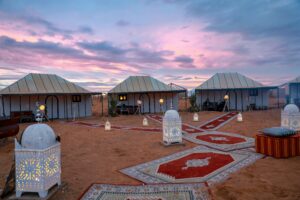
In the Sahara , the shoulder season is when desert camps around Merzouga and the Erg Chebbi dunes actually become livable — daytime temperatures that are brutal in July settle into something far more manageable by October, making camel treks and overnight stays under the stars a realistic option rather than an endurance test. Operators like Sahara Trip Morocco have built their entire calendar around this window, running everything from a 3-Day Sahara Desert Tour from Marrakech to longer, multi-region Grand Morocco Tours that combine the desert with the Atlas Mountains and imperial cities in a single itinerary.
In the north , the Rif Mountains are seeing renewed interest thanks to towns like Chefchaouen, the famous blue-washed city, and Talassemtane National Park, which offers hiking through cedar forests that most visitors never associate with Morocco at all. This region benefits from proximity to Tangier’s improving air links, making it an easier add-on for travelers who’d otherwise never venture past the coast.
Small Operators, Big Opportunity
This regional spread isn’t just a win for infrastructure planners — it’s opening doors for a wave of smaller, more specialized businesses. Adventure tourism outfits, eco-lodges, and cultural immersion agencies are expanding rapidly into towns and regions that, five years ago, barely registered on the average traveler’s itinerary. It’s the kind of ground-level entrepreneurial activity that tends to follow — and reinforce — a genuine shift in demand, rather than a marketing campaign trying to manufacture one.
The Other Side of Growth
It would be dishonest to paint this as a frictionless success story. Rapid growth has outpaced regulation in places, particularly in historic districts, where unlicensed guides, informal transport operators, and street-level scams have become a real headache for both visitors and officials. Industry are voices increasingly vocal about the need for tighter, more consistent coordination between city governments and the national Tourism Ministry — not to slow growth down, but to make sure it doesn’t undercut the experience that’s driving it in the first place.
Planning a Beyond-Marrakech Itinerary
For travelers ready to branch out, a practical way to structure the trip is as a loop rather than a single base:
-
- Start in Rabat (2–3 days) for the capital’s calm pace, the Kasbah of the Udayas, and the Hassan Tower.
-
- Head north to Chefchaouen (2 days) for the blue medina and access to Talassemtane National Park’s cedar-forest hiking trails.
-
- Route south toward the High Atlas , basing in Imlil (2–3 days) for Mount Toubkal treks or the gentler Ourika Valley for day hikes.
-
- Finish in the Sahara near Merzouga (2 days), timing the trip for September through November when desert temperatures are at their most comfortable for camel treks and overnight camps.
October and November are generally the sweet spot for this kind of route: cool enough for the desert and mountains, warm enough for the coast, and ahead of the winter rains that can complicate travel in the Rif.
If you’d rather not piece the route together yourself, Sahara Trip Morocco runs a range of options covering exactly this ground — from focused desert getaways like the 2-Day Merzouga Desert Tour to comprehensive, multi-day Grand Morocco Tours that string together the Atlas, the Sahara, and the imperial cities, plus shorter private excursions for travelers building a custom itinerary around their own Marrakech or Fes base.
What This Means for Travelers
If you’re planning a Morocco trip and your itinerary starts and ends in Marrakech, you’re seeing maybe a third of what the country is currently building toward. Rabat offers a genuinely different urban rhythm. The Atlas and Rif Mountains, especially in the shoulder seasons, offer a version of Morocco that’s less about navigating crowds and more about the landscape itself. And smaller operators springing up in these regions often mean more personal, less commoditized experiences than what you’ll find in the well-trodden center of Marrakech.
Morocco’s tourism story is entering a new chapter — one that’s less about a single iconic destination and more about a country finally showing its full range. The smart move, for travelers and investors alike, is to start paying attention to what’s happening beyond the Red City.
Frequently Asked Questions
Is it safe to travel to Morocco outside of Marrakech and the main tourist cities? Yes — regions like the Atlas Mountains, the Rif, and the Sahara are generally very safe for travelers, including solo travelers. In smaller towns, you’ll often find fewer touts and scams than in busy tourist centers, since these areas rely more on repeat visitors and word-of-mouth than volume tourism.
Do I need a 4×4 or can I visit the Sahara and Atlas Mountains by regular car? Main roads to Merzouga and Imlil are paved and accessible by standard vehicle or shared transport. A 4×4 becomes useful mainly for reaching remote desert camps off the main road or exploring backcountry Atlas trails — most guided tours already include this transport, so you don’t need to arrange it separately.
Is Rabat worth visiting if I’m not there for business? Yes — while Rabat is being marketed toward conferences and corporate travel, its calm medina, coastal Kasbah, and lower tourist density make it a genuinely pleasant 2–3 day leisure stop, especially for travelers who found Marrakech’s pace overwhelming.
What’s the best month to combine the desert, mountains, and coast in one trip? October and November hit the sweet spot: the Sahara has cooled from summer extremes, the Atlas Mountains are clear and hikeable before winter snow, and coastal cities are still mild. March and April offer a similar window in spring.
Are the Rif Mountains and Chefchaouen affected by the same overcrowding as Marrakech? Not yet, though Chefchaouen itself has become a popular Instagram stop and can feel busy at peak midday hours. The surrounding Rif region and Talassemtane National Park remain quiet by comparison, making early morning or late afternoon the best time to see the town itself.
Can I book a multi-region tour that covers the desert, mountains, and imperial cities together, or do I need separate bookings? Operators like Sahara Trip Morocco run combined Grand Morocco Tours that link the Sahara, Atlas Mountains, and imperial cities into a single itinerary, which is usually more efficient and cost-effective than booking each leg separately.Why Morocco’s Next Tourism